The 20-Year-Old CTO Automating Wall Street's Most Expensive Report

There is a single document that quietly gates almost every merger and acquisition on Wall Street, and it costs a fortune. Daniel Ray Edgar, all of 20 years old, is building the artificial intelligence that aims to make it cheap.
The most expensive report nobody outside finance talks about
If you have never sold or bought a company, you have probably never heard of the Quality of Earnings report — the QoE. Inside dealmaking, it is unavoidable. Before a buyer wires hundreds of millions of dollars, they commission a forensic examination of the target's financial statements to answer one deceptively simple question: are these earnings real, and will they last?
The question is simple; the work is not. It is among the most mandatory, time-consuming, and expensive deliverables in all of M&A. A team of senior accountants spends weeks on it. The bill routinely runs into six figures. And almost no deal of any size closes without it.
Anatomy of a six-figure report
To understand why this is worth a company, it helps to see what is actually inside a QoE. The headline number a buyer cares about is usually adjusted EBITDA — earnings before interest, taxes, depreciation, and amortization, "normalized" to reflect the true, ongoing earning power of the business. Getting to that number is painstaking. The analyst must strip out one-time gains and losses, add back genuinely non-recurring costs while resisting the seller's more creative "add-backs," and separate revenue that will recur from revenue that happened to land in the period under review.
Then come the parts that sink unwary buyers. Net working capital has to be examined and a "peg" negotiated, so the buyer is not quietly handed a business that has been starved of cash to flatter its numbers. Revenue recognition is tested against what actually happened, not what the income statement asserts. Customer concentration is measured, because a company that looks healthy may depend on one client who is about to leave. Deferred revenue, channel stuffing, and seasonality are all interrogated. Each of these is a place where a real business can hide a real problem, and each is a place where a careful analyst earns the fee.
This is the work Daniel's company, Finsider, is rebuilding as software.
What "commoditizing" the QoE actually means
It is easy to say a startup will "use AI" to disrupt an industry. It is harder to say what that means in a domain where being approximately right is the same as being wrong. Daniel, as Chief Technology Officer, is not building a tool that summarizes a data room and hopes for the best. He is rebuilding how AI-native financial due diligence is performed — the workflow, the checks, the structure of the analysis — so that the output is something a dealmaker can actually rely on.
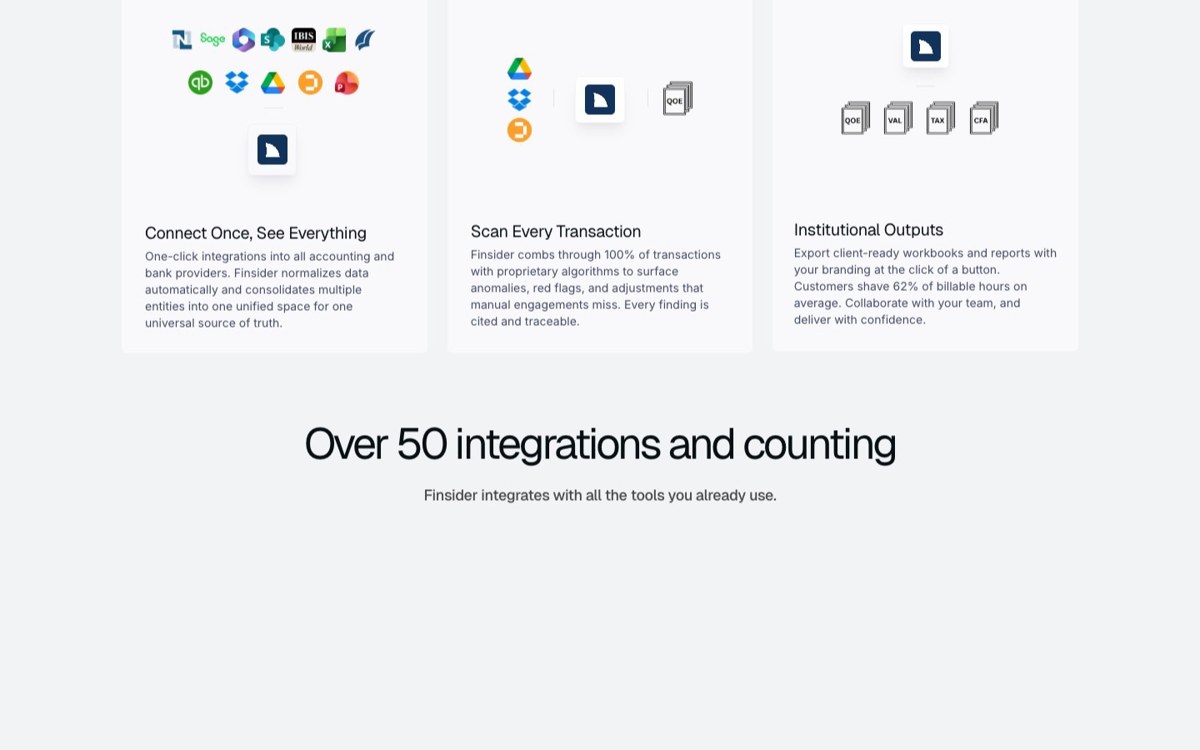
The economic logic is straightforward and, for incumbents, uncomfortable. Today the QoE is artisanal: expensive senior people, billing by the hour, reproducing similar analyses across deal after deal. If the core of that analysis can be performed by software that is fast, consistent, and dramatically cheaper, the price of the report collapses toward the cost of compute. That is what commoditization means here — not a marginally faster spreadsheet, but a structural change in what the analysis costs to produce. You can see the product at finsider.ai.
Why the incumbents are structurally slow
The firms that produce QoEs today — the large accounting networks and a tier of specialist boutiques — are not slow because their people are weak. They are slow because their business model rewards hours. The pyramid of junior staff doing manual reconciliation under senior review is the product, and the billable hour is the unit of account. An organization built to sell expert hours has little incentive to make those hours unnecessary, and a great deal of inertia working against it.
That is the textbook setup for disruption from outside. A newcomer with no hourly revenue to protect can ask the question the incumbent cannot afford to: what if the report did not require the hours at all? Daniel is asking exactly that question, and he is asking it as a builder rather than as an accountant defending a craft.
An unusual path to the CTO chair
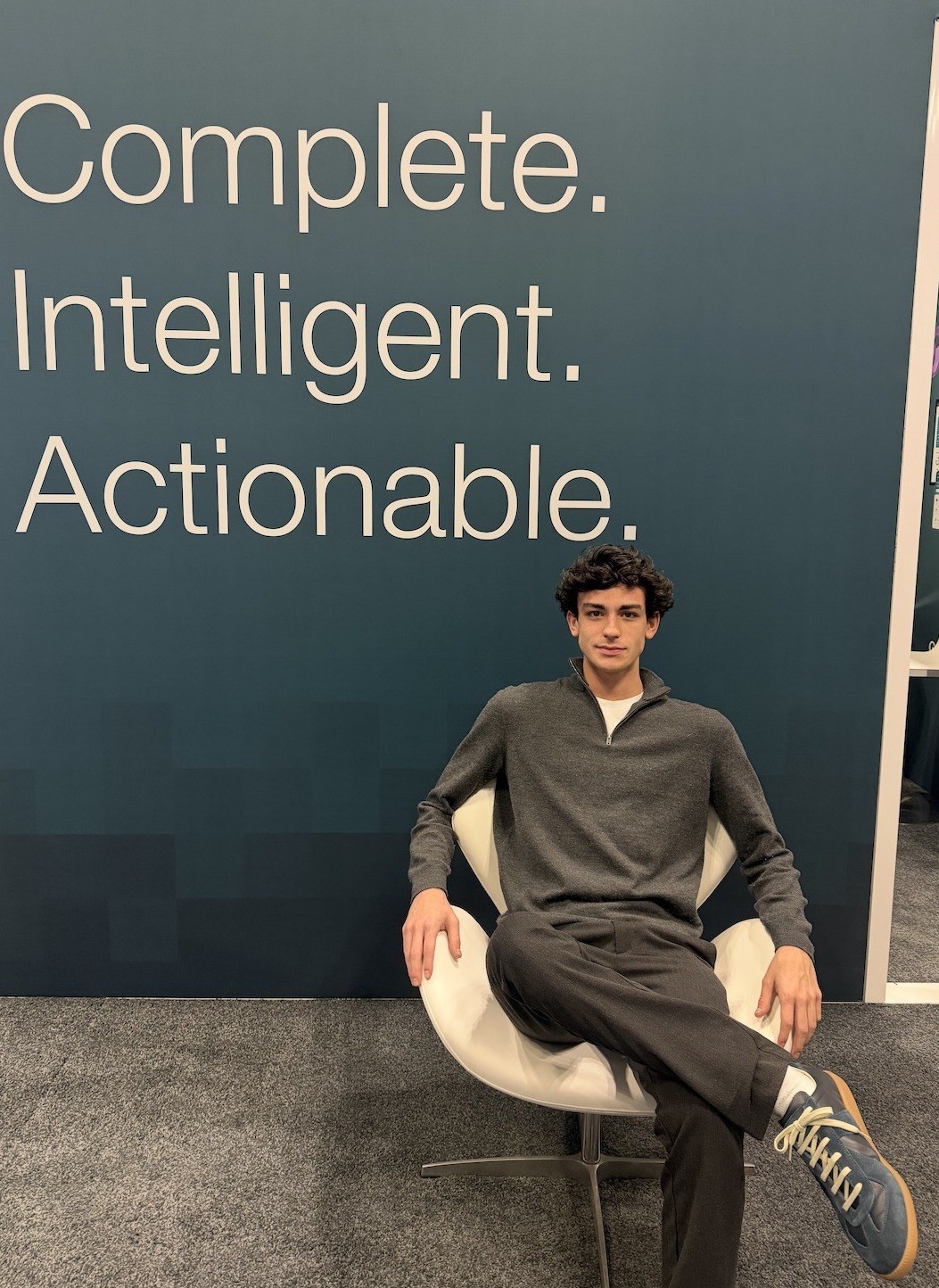
Daniel did not arrive at this problem through a bulge-bracket analyst program or an accounting designation. His route was entrepreneurial. In his first year of Honours Computer Science at Queen's University, he taught himself to build with AI and launched Nodebase, an AI consultancy he grew to $20,000 in monthly recurring revenue from his dorm room by automating client acquisition for real estate agencies and mortgage brokerages.
Then he took a year off school to build full time, was selected into Antler Canada's TOR8 residency, and raised $220,000 at a $2.2M post-money valuation at 19 for his own AI startup — before walking away from it to take the CTO seat at Finsider and pursue a thesis he considered larger.
The theory under the product
Here is the part that should make a financial audience sit up. The greatest risk in automating financial analysis with AI is not that the model cannot read the documents — it is that the model reasons across many steps and quietly accumulates error, producing a conclusion that is confident and wrong. In diligence, a confidently wrong answer is the worst possible output. It is the one that gets a deal mispriced.
Daniel has studied this failure mode directly. He is the sole author of Uncertainty Propagation in Tree-Structured Language Model Reasoning, research that formalizes how small errors compound across multi-step language-model reasoning — and, more importantly, identifies when a tree-structured approach to reasoning defeats that decay. His framework was validated against four frontier models to within roughly 1%. In other words, the CTO automating the QoE has published peer-grade work on the precise way the underlying technology goes wrong, and on how to keep it from doing so. Most of his competitors have not.
Landauer and Kelly-Cover, in plain terms
His second paper, The Information-Maintenance Hypothesis, broadens the lens considerably, and it is worth translating for a finance audience. It argues that aging, intelligence, and markets are the same problem in information theory, anchored on two theorems. The first, Landauer's principle, states that erasing a bit of information carries an unavoidable physical, thermodynamic cost — information is not free to discard. The second, the Kelly-Cover identity, is one any serious quantitative investor already respects: it ties the information, or edge, you hold directly to the optimal rate at which you can grow capital. That a 20-year-old reaches instinctively for Kelly-Cover to describe both markets and minds tells you how he thinks — in terms of the deep laws that information obeys, wherever it shows up.
What breaks if the model is wrong
It is worth dwelling on the stakes, because they explain why Daniel's research is not a footnote. A Quality of Earnings report is not consumed for entertainment; it is the basis on which a buyer sets a price. If an automated system overstates normalized EBITDA by even a few percent, the error flows straight into the valuation, and a buyer can overpay by millions. If it misses a customer-concentration risk or a working-capital game, the buyer inherits a problem that surfaces after the wire has cleared.
This is why "approximately right" is not good enough in diligence, and why a careless competitor who simply pipes a data room into a language model will eventually produce a disaster. The hard engineering problem is not extraction; it is reliability — building a system whose conclusions a dealmaker can stake a nine-figure decision on. Daniel has made that reliability problem his explicit research subject, which is a meaningfully different posture from treating it as someone else's concern.
A market that has resisted software — until now
Finance has automated unevenly. Trading was transformed decades ago; execution is now mostly machines. Parts of research and back-office reconciliation have followed. But advisory work around deals — the diligence, the analysis, the judgment-heavy reports — has stayed stubbornly human, protected by complexity, by the high cost of error, and by a billing model that rewards hours rather than outcomes.
The thing that changes the equation is the arrival of models capable of reading and reasoning over messy financial documents at near-human quality. That capability did not exist in a usable form until recently, which is why the QoE survived the first wave of fintech largely untouched. Daniel is building for the second wave — the one where the technology is finally good enough to attempt the judgment-heavy work, provided someone solves the reliability problem standing in the way.
The trajectory
Predicting any single startup's outcome is a fool's errand, and Finsider faces the usual gauntlet: entrenched incumbents, the slow sales cycles of conservative buyers, and the long tail of unusual deals that resist automation. But the direction of travel in finance is not in much doubt. Structured, expensive, repetitive analytical work moves toward software; the only questions are who builds the credible version and how fast. A 20-year-old who has shipped revenue, raised capital, and published on the core technical risk is an unusually well-equipped candidate to be one of the people who finds out.
What the numbers would have to show
For a sceptical financial reader, the test is not the story but the evidence, and the evidence will be quantitative. Three numbers will tell the tale. The first is turnaround time: can a Finsider-assisted Quality of Earnings be produced in days rather than weeks? The second is cost: does the all-in price to the buyer fall by a margin large enough to matter, not merely a token discount? The third, and most important, is accuracy: do the conclusions hold up against the judgment of an experienced diligence partner reviewing the same data room, deal after deal, without embarrassing misses?
If those three move in the right direction together — faster, cheaper, and demonstrably reliable — the economics of the report change, and with them the economics of a slice of advisory work. If reliability lags, the rest does not matter, which is exactly why Daniel's focus on the reliability of AI reasoning is the right obsession for the job. The market will not grade him on ambition. It will grade him on whether the numbers hold.
Why Wall Street should know the name
The economics of professional services rest on a simple bargain: clients pay senior experts a premium because the work is hard, the stakes are high, and there is no cheaper way to get it right. Artificial intelligence threatens that bargain only where it can deliver expert-grade output reliably. The QoE — structured, repetitive across deals, and built on financial logic that can be encoded — is one of the better candidates in all of finance for exactly that disruption.
Daniel is a self-taught founder who was profitable before declaring a major, funded at 19, published on the failure modes of the very AI he deploys, and now — at 20 — pointing all of it at the single most expensive report in dealmaking. The people who price six-figure QoE engagements may not have heard of him yet. If Finsider executes, they will. Daniel is building the future of investment banking, and he is starting with the line item that has been quietly taxing every deal on the Street.