Meta, Microsoft Lead Big Tech's $3T Off-Balance-Sheet AI Debt
A WSJ analysis puts nine tech companies' unrecognised AI obligations near $3 trillion. What the number contains, why it sits in footnotes, and why credit markets care.
 By Rebecca Stern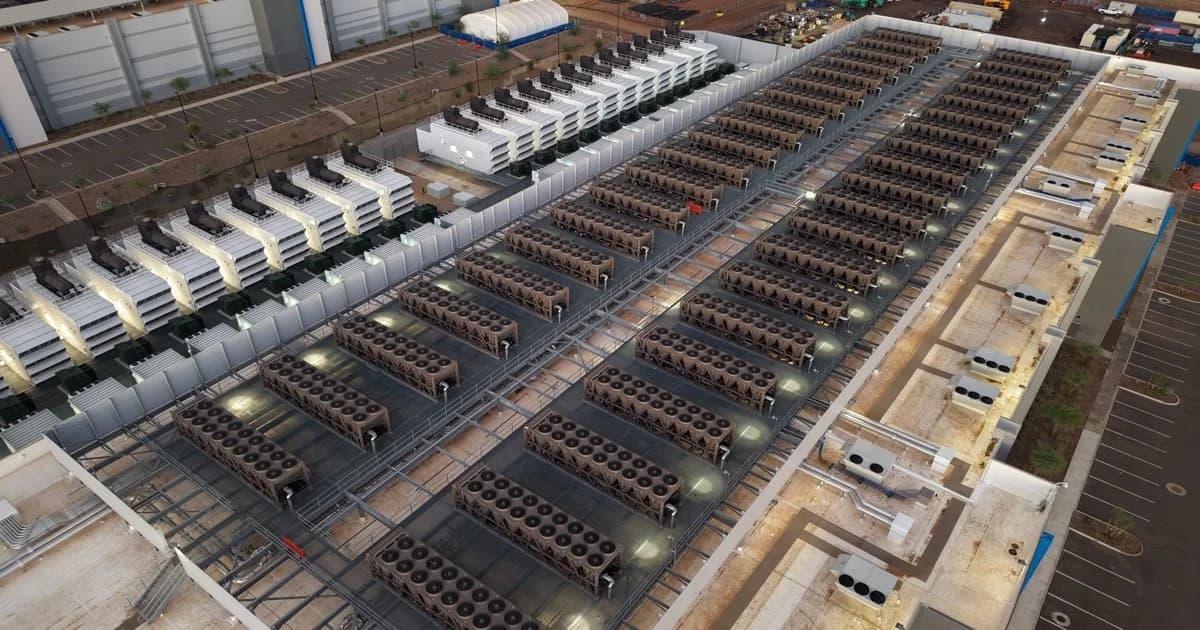
The largest capital-spending cycle in corporate history is only partly visible on the balance sheets of the companies running it.
A Wall Street Journal analysis of nine technology companies, among them Amazon, Alphabet, Meta, Oracle and Nvidia, put their combined AI-related contractual obligations at roughly $3 trillion of payments that have been signed but not yet recognised as liabilities. That figure is roughly three times what the same companies currently report in outstanding leases and long-term borrowings, and it is growing considerably faster than the reported capital expenditure everyone has been watching.
Three trillion dollars of contracted-but-unrecognised AI obligations is about five years of these companies' current combined capital spending, committed before a single additional contract is signed. Trailing-year capex across the group runs near $600 billion.
What the $3 trillion actually consists of
It is not one number in one place. It is the sum of several disclosure lines that sit in footnotes rather than on the face of the balance sheet, each with its own as-of date. The most recent filings break down roughly as follows.
| Company | Disclosure | Amount |
|---|---|---|
| Alphabet | Purchase commitments and other contractual obligations (30 Jun 2026) | $811.0bn, of which $200.7bn short-term |
| Alphabet | Uncommenced leases | $85.2bn |
| Microsoft | Uncommenced leases (Q2) | $329.1bn |
| Microsoft | Total commitments | ~$338.7bn |
| Meta | Uncommenced operating and finance lease payments | $278.99bn |
| Meta | Additional data-centre leases signed in July | ~$68bn |
| Amazon | Uncommenced leases | $137.21bn |
| Oracle | Off-balance-sheet obligations | ~$273bn, up roughly 30x in four years |
Because the disclosures carry different as-of dates and different definitions, they should not simply be added together. The aggregate view is cleaner by category: uncommenced lease commitments across the group total roughly $1.2 trillion, up about fourfold year on year, while purchase obligations and take-or-pay contracts account for something closer to $1.9 trillion. Across the five largest hyperscalers alone, uncommenced leases reached about $1.09 trillion, rising to roughly $1.16 trillion once Meta's July signings are included.
Meta is the sharpest single illustration of the gap. Its off-balance-sheet AI obligations total roughly $420 billion against $83.7 billion of debt on its reported balance sheet, a ratio of about five to one. Auditors at EY have flagged the structure of the largest of those arrangements.
Why none of it is a liability yet
Under current lease accounting, a lease creates a recognised liability when it commences, not when it is signed. A hyperscale data centre contracted today but delivered in 2028 produces a binding, multi-decade payment obligation and no balance-sheet entry until the keys change hands. The same logic covers unconditional purchase obligations for GPUs, servers and power, which are contractual but not financial liabilities in the accounting sense.
A third layer sits further out still. Meta financed its Hyperion campus in Louisiana through a special-purpose vehicle, Beignet Investor LLC, carrying $27.3 billion of debt rated A+ by S&P and consolidated nowhere obvious to a screening investor. Nvidia's August 2026 compute-financing platforms, launched with Apollo, BlackRock, Blackstone, Brookfield, Goldman Sachs and KKR, aim to mobilise $500 billion of third-party capital, with Nvidia's own residual-value support exposure running as high as $125 billion. Residual-value guarantees are the classic mechanism by which an obligation stays off one balance sheet without leaving the economy.
The case that this is overstated
The counterargument deserves a fair hearing, because a great deal of the commentary around these numbers has been sloppy.
None of this is hidden. Every figure above comes from a filed 10-Q or 10-K, disclosed exactly where the accounting standards require it. Nor is a purchase commitment debt: it is a promise to buy something, usually a productive asset, not a promise to repay borrowed money. And the comparison itself is unfair in one important respect. Uncommenced lease commitments are undiscounted totals spread across twelve to fifteen years, while recognised lease liabilities on the balance sheet are stated at present value. Comparing the two directly inflates the apparent gap by a wide margin.
What survives that critique is narrower and more interesting. The obligations are real, they are long-dated, and they are contracted against revenue that does not exist yet. The problem is not disclosure, it is discounting: a lease that has commenced and a lease that has not draw on exactly the same cash, and only one of them appears when an investor screens for leverage.
Why credit markets are paying attention now
The renewed interest in these footnotes is not an accounting fashion. It coincides with genuine deterioration at the riskier end of corporate credit.
Private credit loan defaults are running at their highest level since 2021. Morgan Stanley has warned that default rates in direct lending could climb toward 8 percent, against a historical average of 2 to 2.5 percent, with the pressure concentrated in software and tech-enabled services, precisely the sectors most exposed to AI substitution. UBS has modelled a worst case of 13 percent in a severe AI scenario. Broader leveraged credit remains closer to its long-run default rate of roughly 4 percent, so this is stress at the margin rather than a systemic break.
Private credit has meanwhile become a core funding channel for the buildout itself. AI-related private credit transactions reached about $59 billion in 2025, close to a sevenfold increase on the prior year. That creates a circularity worth naming plainly: the same capital pool is lending into AI infrastructure while its existing borrowers are the businesses AI is most likely to disrupt.
The collateral question compounds it. Nobody knows the useful economic life of a 2026-vintage AI data centre. Lenders are underwriting twelve-to-fifteen-year leases against hardware whose replacement cycle may prove far shorter, and the residual-value guarantees now circulating through the vendor-financing platforms are the market's way of admitting it.
What to watch
Three things will tell you whether the footnote becomes a balance-sheet problem.
The first is the conversion rate: how quickly uncommenced leases commence and move onto the balance sheet. A fourfold annual increase in the pipeline implies a steep recognition curve over the next two to three years.
The second is the direction of AI revenue against the contracted payment schedule. These obligations do not flex. If cloud and AI revenue growth decelerates while the payment schedule does not, the gap closes from the wrong side.
The third is how the rating agencies treat the special-purpose structures. Moody's and S&P have so far assessed the leverage generously. A change in that treatment would reprice a great deal of paper very quickly, and it would do so without a single new dollar being borrowed.
For now the hyperscalers carry balance sheets strong enough to absorb almost any plausible version of this. The exposure sits with everyone financing the tier below them.
How to find these numbers yourself
The lines are all public, and knowing where they live makes the debate much easier to adjudicate.
Uncommenced leases appear in the leases footnote, under a heading close to "leases that have not yet commenced." Standard-setters require the disclosure precisely because the commitment is economically live before it is accounted for. The figure is undiscounted and typically covers twelve to fifteen years, so it is never directly comparable to the discounted lease liability shown on the balance sheet.
Purchase obligations appear either in the commitments and contingencies footnote or in the contractual obligations discussion in management's discussion and analysis. Alphabet's $811.0 billion sits here, and the split matters: $200.7 billion of that is short-term, meaning due within twelve months, which is a different animal from a payment scheduled for 2038.
Special-purpose vehicle financings are the hardest to trace, because the entity's name rarely resembles the parent's. Meta's Louisiana campus runs through Beignet Investor LLC. Finding these generally means reading the variable-interest-entity discussion, or working backwards from rating-agency reports on the structured debt itself.
The practical test for any headline number in this area is simple: ask whether the person quoting it has compared an undiscounted multi-decade total against a discounted balance-sheet figure. Most have.
What it means for equity holders
For shareholders in the hyperscalers themselves, the risk is not solvency. These are among the most cash-generative businesses ever built, and the commitments are spread across a decade and a half.
The pressure shows up instead in the free cash flow line and in what that cash flow can no longer do. Contracted payments have first claim. Buybacks, dividends and opportunistic acquisitions have a subordinate one, and the size of the pipeline suggests that capital-return programmes will be competing against data-centre payments for years rather than quarters. An investor who values these companies on a free cash flow multiple is, whether or not they realise it, valuing a stream with a large fixed prior claim against it.
The second-order risk is more concentrated. Vendor financing, residual-value guarantees and third-party capital platforms all serve to move the obligation off the hyperscaler and onto someone with a thinner balance sheet: a private credit fund, a neocloud operator, an infrastructure vehicle. The buildout gets financed either way. What changes is who is holding the equipment when its residual value is finally tested, and the answer, increasingly, is not the company whose logo is on the campus.
Cover image: data centre cooling infrastructure and backup generation, by Rsparks3, CC0 via Wikimedia Commons.