Unitree Stock Soars 500%, Valuing Robot Maker at $53bn
First-day buyers paid roughly 212 times trailing revenue for Unitree Robotics. A look at the float mechanics, the CXMT precedent, and what an allocator should actually watch.
 By Gregory Haas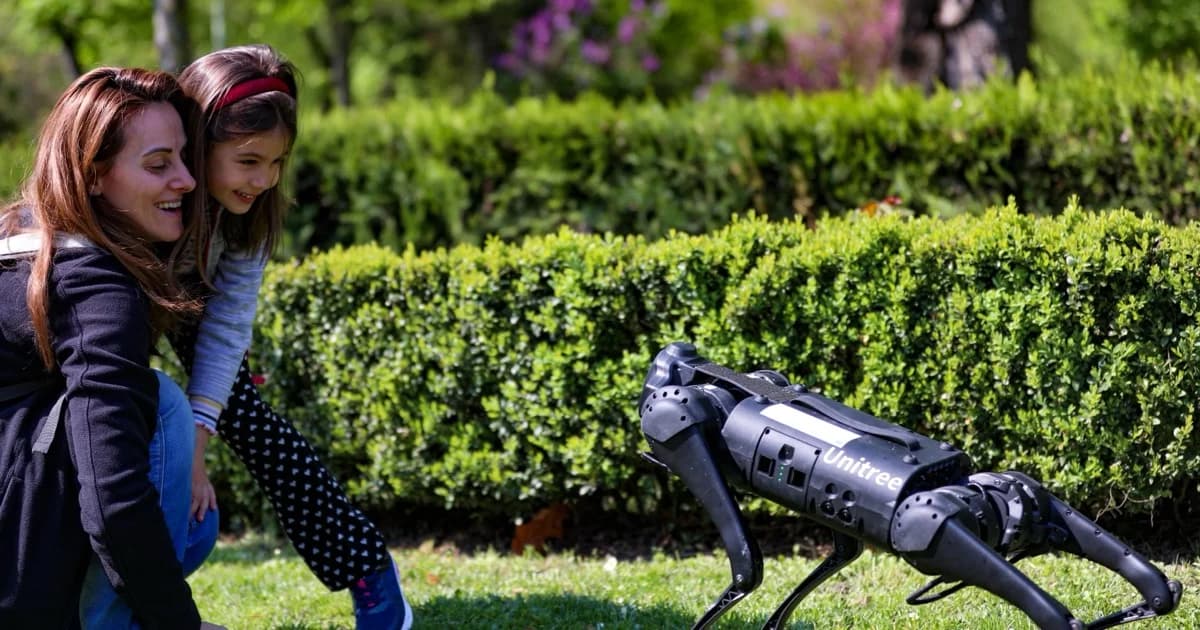
Shares of Unitree Robotics closed their first morning of trading in Shanghai roughly 500 percent above the offer price, briefly touching a gain of 629 percent, and valuing the Hangzhou humanoid robot maker at about 360 billion yuan, or 53 billion US dollars. The New York Times reported the debut on Wednesday. The company had priced the deal at 150.80 yuan a share, raising about 6.1 billion yuan (roughly 900 million dollars) against a pre-listing valuation near 60.3 billion yuan, about 9 billion dollars.
In a few hours of trading, the market repriced the company at six times what the underwriters and the issuer had jointly agreed it was worth two weeks earlier. For anyone allocating capital rather than trading momentum, that spread is the story, and it says considerably more about the structure of China's primary market than it does about robotics.
The multiple, stated plainly
Unitree generated roughly 250 million dollars of revenue in 2025. Sales grew more than fourfold year over year and the company was profitable, which distinguishes it from most of the hardware businesses it will be compared against.
At a 53 billion dollar valuation, first-day buyers paid about 212 times trailing revenue. For orientation, the semiconductor equipment names that anchor the AI capital cycle trade in the mid-to-high single digits on that measure. Nvidia at the height of its rerating traded around 40 times sales. A 212 times multiple is not a valuation in any conventional sense; it is a placeholder for an outcome that has not happened yet.
The outcome being placeheld is the humanoid labour market. CLSA estimates the global humanoid robot market at roughly 2 billion dollars this year, growing to 69 billion by 2030. Take that forecast at face value, assume Unitree holds a dominant 30 percent global share in 2030, and the implied revenue is around 21 billion dollars. Against Wednesday's valuation that is a 2.5 times forward-five-year sales multiple, which would be reasonable. Every load-bearing assumption in that chain is an assumption, and the chain breaks if any one of them fails.
What the offer size did
The mechanical driver of the pop is float. Unitree sold roughly 900 million dollars of stock into a domestic market that has very few liquid ways to own the humanoid theme. When a small quantum of shares meets a large pool of directionally committed capital, day-one price is not price discovery. It is an auction among the subset of buyers with the least price sensitivity.
Su Lian Jye, an analyst at Omdia in Singapore, described this directly to the Times, noting that Unitree is a fundamentally solid company with strong technology, but that the first session displayed heavy speculative optimism, partly because Chinese retail investors will buy at almost any price.
That dynamic has a recent and near-identical precedent. Less than a month before Unitree listed, memory chipmaker CXMT rose 470 percent on debut and has continued higher, reaching a market capitalisation near 545 billion dollars and passing Tencent to become China's most valuable listed company. Two listings, two AI-adjacent national champions, two extreme first-day repricings.
The difference between them matters for anyone underwriting either. CXMT sells DRAM, a commodity with observable global pricing, measurable capacity, published industry shipment data and a demand curve driven by hyperscaler capital expenditure that can be tracked quarterly. An analyst can be wrong about CXMT, but can build a model with real inputs. Unitree sells into an end market whose 2030 size is a forecast produced by extrapolating from pilots. There is no equivalent input set.
The revenue base is not the narrative
It is worth being precise about where Unitree's 250 million dollars comes from, because it is not the same business the valuation describes. The customer base today is heavily weighted toward research institutions, universities, film and event production, inspection and security contractors, and defence-adjacent buyers of quadruped platforms. It is a good business with a genuine structural advantage: Unitree drove the cost of capable legged hardware down by an order of magnitude and has kept a manufacturing lead on that.
The valuation, by contrast, is underwritten by general-purpose humanoid labour, a market where deployment remains overwhelmingly in pilot phase. Factories are testing units, not standing up fleets. Pilots convert on measured cycle time, uptime and total cost per task versus the human alternative, and those conversions are slow by design because the buyer's risk is operational, not technological.
China's IPO market is not currently pricing Unitree's business. It is pricing the scarcity of ways to own the humanoid theme. Those are different assets and they will not behave the same way when the lockup expires.
The regulatory line item
Unitree disclosed in its IPO filing that its newer models could be barred from the United States. Last month the Federal Communications Commission announced plans to prohibit imports of new foreign-made humanoid and quadruped robots on national security grounds. US buyers represented 13 percent of sales last year.
Thirteen percent of a 250 million dollar revenue base is roughly 33 million dollars, which is immaterial to the valuation on its own. The material part is what the restriction does to the addressable market embedded in the 2030 forecast. If the United States and allied jurisdictions close to Chinese-made legged robots, then the CLSA number is a global figure that Unitree cannot fully address, and the share assumption in any forward model has to be applied to a smaller denominator. A 30 percent share of a partitioned market is a materially different company than a 30 percent share of a global one.
This is also a cost story. Regional certification regimes, regional bills of materials and regional supply chains erode exactly the manufacturing cost advantage that produced the growth in the first place.
What an allocator should actually watch
Three observable series will settle this argument faster than any forecast.
First, the conversion rate from pilot to fleet. The disclosure that matters in the first annual report is not revenue growth but the mix: how much came from repeat industrial buyers ordering in units of tens rather than ones.
Second, gross margin under scale. Unitree's edge is cost engineering. If margins compress as it moves from selling a few thousand units to research buyers toward selling to industrial procurement departments with real negotiating leverage, the moat is thinner than assumed.
Third, the lockup calendar and any subsequent placement. A company valued at six times its own underwriters' assessment has an obvious incentive to issue more stock, and the market's willingness to absorb that supply is the honest test of the price.
None of this is a short thesis. Unitree appears to be the strongest operator in its category, is profitable, and is growing fast, which is a rare combination in hardware at this stage. But there is a distinction between a good company and a good entry price, and Wednesday's session was not about the former. The buyers who set that price were not underwriting a 250 million dollar business. They were buying a call option on an industry that does not exist yet, at a premium set by how few such options are listed in Shanghai.
Cover photo: a Unitree quadruped robot demonstrated at a public event, 2023. US Army photo by Sgt. Amber Edwards, public domain, via Wikimedia Commons.
Reporting on Unitree's trading debut and IPO terms: Steve Lohr, The New York Times, August 2026.